Execution essay
Why You Lose Momentum
Momentum rarely disappears in one dramatic moment.
It usually leaks out through a series of ordinary days where the important work gets touched a little less, reviewed a little less, and protected a little less.
Where it breaks
People often think momentum is a magical state they either have or do not have. That makes it easy to miss what actually kills it. Small drift. A few low-priority days. Too many open loops. One avoided task turning into a pattern.
By the time you say, 'I lost momentum,' the breakdown has usually been happening quietly for a while.
What the pattern reveals
Momentum survives when priorities stay visible, next actions stay concrete, and reflection catches drift early. Intensity alone burns too unevenly.
When those supports disappear, momentum gets replaced by vague busyness and low-level guilt.
Why it keeps happening
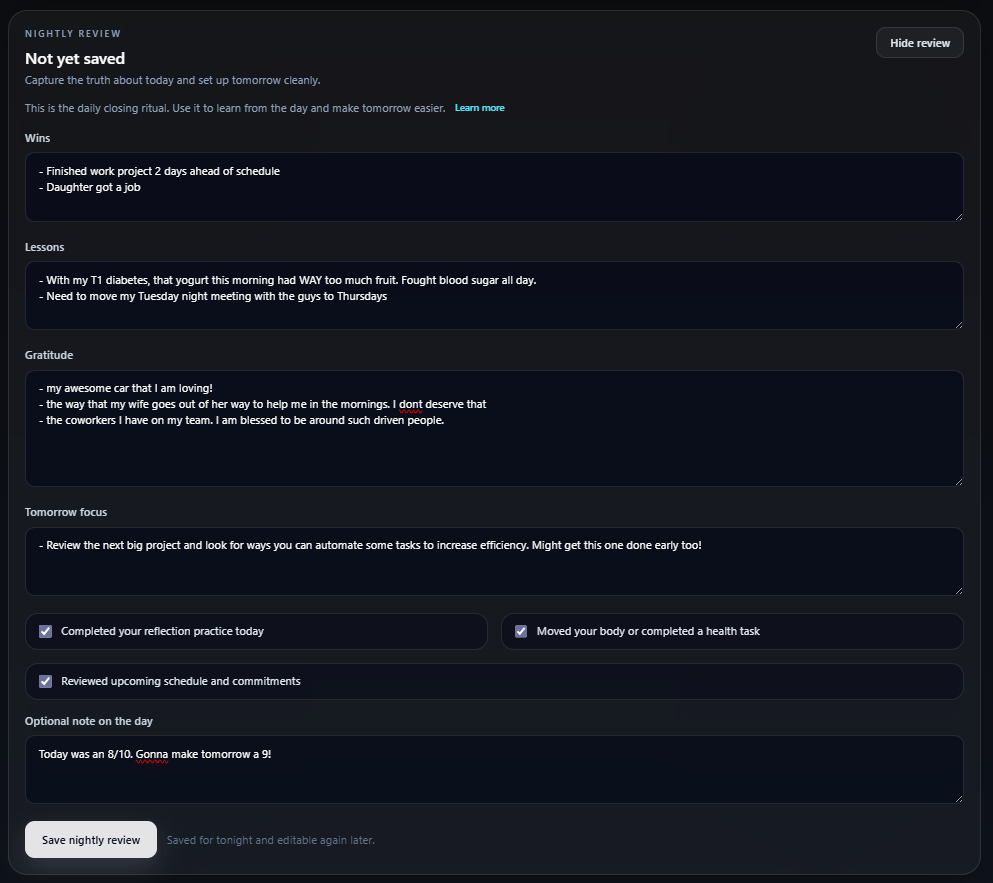
Without review, you cannot see the slope. You only feel the result once the distance is large enough. That is why so many people think the problem came out of nowhere. It did not. The system just never surfaced it in time.
This is one reason starting things and not finishing them becomes such a painful pattern.
A workable response
Protect a small number of priorities and keep a lightweight Daily Close. Watch for carryover, a bloated active list, and days that no longer match the plan.
Momentum becomes easier to keep when the system tells the truth early.
Put it into practice
Treat momentum as an operating condition. Keep the active layer clean, move future work out of today, and review often enough to catch misalignment early.
Then momentum stops feeling mysterious. It becomes the natural result of a tighter feedback loop.
How Outcomes OS supports the work
Outcomes OS is designed to protect momentum through visibility, structure, and review. It helps you see the drift while it is still small enough to correct.
If you want the deeper principle behind this, read how to build real consistency.