Execution essay
Why You Can’t Focus for More than 10 Minutes
When focus is gone, even small tasks can feel slippery.
You sit down with good intentions, and within minutes your attention has already been stolen by something easier, louder, or more stimulating.
Where it breaks
It is tempting to assume your brain is just broken or ruined by modern life. But a lot of the time, poor focus is a downstream effect of how your work is structured. Too many open loops. Too many priorities. Too much ambiguity.
The more unresolved decisions the day contains, the harder it is to hold your attention on one meaningful thing.
What the pattern reveals
Focus improves when the target is clear and the surrounding noise is reduced. Punishment only adds another source of friction.
Focus improves when fewer things are competing for the same attention.
Why it keeps happening
A bloated task list creates cognitive drag. So does uncertainty about what matters now. If every task feels equally present, your attention keeps hopping because nothing has been defined as the true center of the day.
That is part of how to structure your day for success: protect attention by reducing choice overload.
A workable response
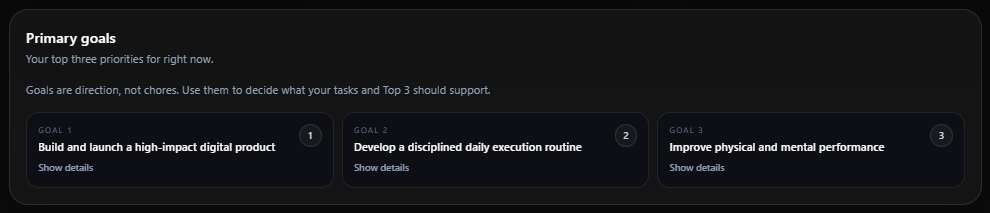
Narrow the active field. Choose a real Top 3, move future work somewhere else, and make the next action visible before the work block begins.
This does not solve every focus issue, but it removes a huge amount of unnecessary drag.
Put it into practice
Define the day before it starts, then review where your attention actually went. Repeated often enough, focus becomes a skill you can observe and improve.
When the system supports attention, concentration starts feeling less like luck.
How Outcomes OS supports the work
Outcomes OS helps by keeping priorities clear, task states separated, and drift visible. It reduces the amount of friction your attention has to fight through before work even begins.
If your problem feels more like mental spinning than pure distraction, read how to stop overthinking and start doing.